How does CiteTrue determine the accuracy of a citation?
CiteTrue determines citation accuracy using a proprietary scoring model that checks various parameters like author names, publication years, journal titles, and DOIs from the available academic databases.
What does the confidence score provided by CiteTrue signify?
The confidence score given by CiteTrue communicates the likelihood of a citation being genuine and accurate. A higher score means a higher probability of citation authenticity and accuracy.
What kind of user is CiteTrue intended for?
CiteTrue is intended for researchers and students who are looking to ensure their citations' accuracy and authenticity. It can also be used by educators reviewing student papers or by academics validating citations when reviewing others' work.
Does CiteTrue offer citation formatting correction?
Yes, CiteTrue has a feature that auto-corrects the format of input citations before the verification process to ensure they're properly formatted.
Can CiteTrue verify citations from books and academic journals?
Yes, CiteTrue can verify citations from a range of academic materials, including books and academic journals, by cross-referencing them against authoritative academic databases.
Does CiteTrue protect academic integrity?
Yes, CiteTrue helps maintain academic integrity by providing exhaustive citation checking. It flags potentially false or AI-generated citations, thereby aiding in the prevention of academic fraud or plagiarism.
How can CiteTrue help me prevent research misdirection?
CiteTrue aids in preventing research misdirection by verifying and ensuring the accuracy and authenticity of all citations referenced in your research material. By using CiteTrue, you can rely confidently on your sources, knowing they've been cross-referenced for authenticity with authoritative databases.
Can CiteTrue check multiple citations at once?
Yes, CiteTrue can check and verify multiple citations in a single click, making citation verification a highly efficient process for researchers.
What is the range of academic databases that CiteTrue uses?
CiteTrue accesses an extensive range of authoritative academic databases for citation verification, including but not limited to Crossref, arXiv, CORE, OpenAlex, PubMed, ScienceDirect, SemanticScholar, OpenLibrary, Cambridge University, IEEE, Springer, Wiley, ACM, Elsevier, BMC, and ResearchGate.
Does CiteTrue provide any tools to educators for student paper reviews?
Yes, educators can use CiteTrue when reviewing student papers or academic research submissions. This tool helps ensure the accuracy of citations and flags any potential academic integrity issues, making it a vital tool in the academic verification process.
What parameters does CiteTrue check in a citation?
CiteTrue checks parameters like author names, publication years, journal titles, and DOIs during the citation verification process.
Can I maintain my academic reputation by using CiteTrue for citation checks?
Yes, by using CiteTrue for citation checks, you ensure the authenticity and accuracy of your citations. This maintains your academic reputation, reducing the likelihood of using unverified or inaccurate citations.
How does CiteTrue help in upholding the authenticity of my academic research?
CiteTrue supports the authenticity of academic research by cross-referencing and verifying every citation against authoritative academic databases. It flags potentially false or AI-generated citations and provides a confidence score, helping maintain reliable and credible research.
How reliable is the citation verification scoring model used by CiteTrue?
The citation verification scoring model used by CiteTrue is reliable as it's based on the cross-verification of citation details against comprehensive academic databases. The model uses cutting-edge AI and algorithms and has been designed specifically to evaluate citation accuracy.
What is CiteTrue?
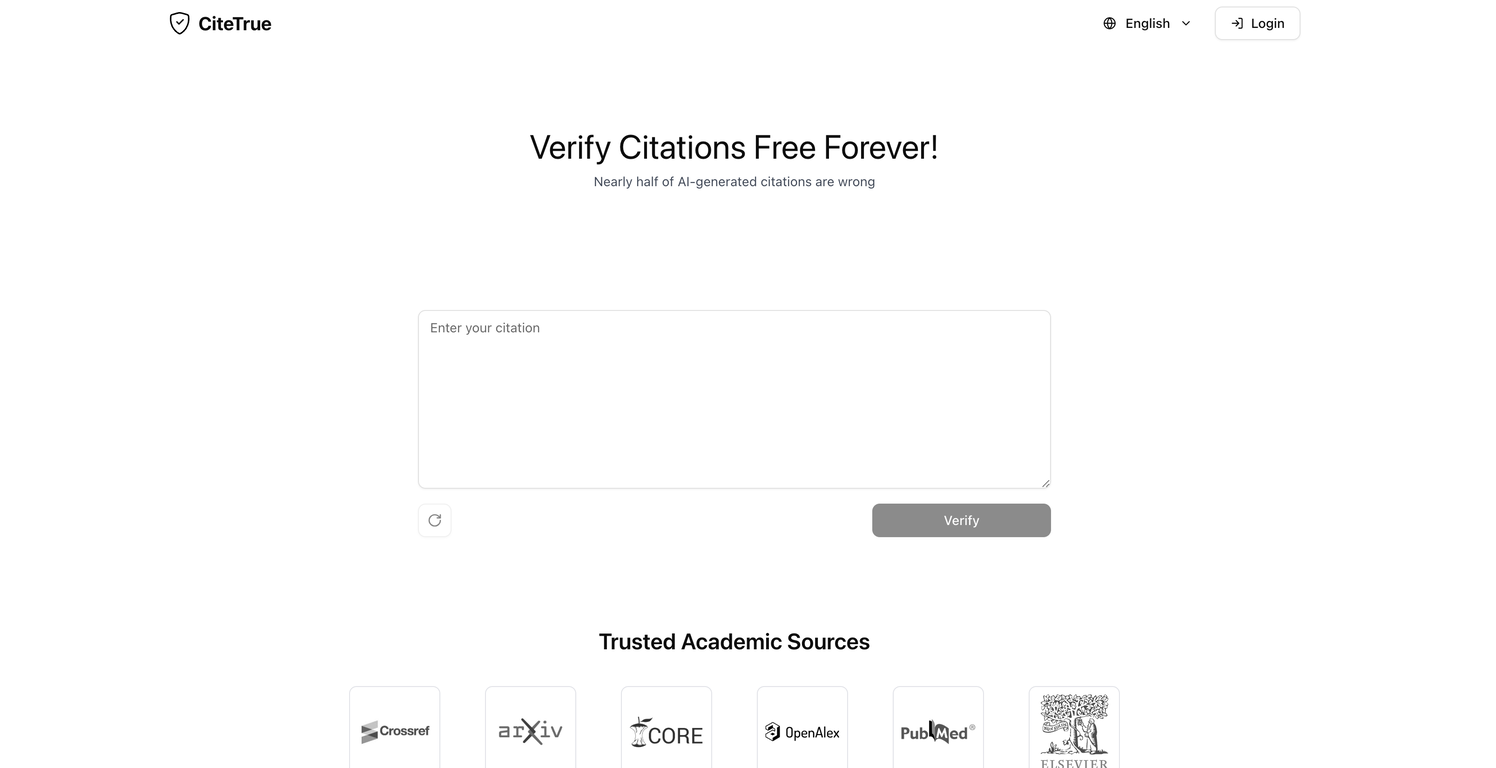
CiteTrue is an AI-powered citation verification tool that helps researchers and students ensure the authenticity and accuracy of their citations. It checks citations against a vast number of authoritative academic databases to identify any that may be artificial or inaccurate.
Is CiteTrue free to use?
Yes, CiteTrue is free to use and is designed to be user-friendly for academic citation verification.
How does CiteTrue work?
CiteTrue works by employing advanced retrieval algorithms and state-of-the-art AI language models to cross-verify citations against millions of academic papers, journals, and books. It checks various parameters like author names, publication years, journal titles, and DOIs using a proprietary scoring model to ensure citation accuracy.
Who is CiteTrue designed for?
CiteTrue is designed primarily for researchers and students who wish to ensure the accuracy and authenticity of their citations when writing papers, conducting academic research, reviewing papers or academic research submissions.
What parameters does CiteTrue check for in a citation?
CiteTrue checks various parameters in a citation, including author names, publication years, journal titles, and DOIs.
How reliable is the citation analysis from CiteTrue?
The citation analysis performed by CiteTrue is highly reliable, thanks to its sophisticated retrieval algorithms and AI language models. The tool uses a proprietary citation verification scoring model, which evaluates the authenticity and accuracy of each citation.
Does CiteTrue provide a confidence score?
Yes, CiteTrue does provide a confidence score. This score indicates the probability of each citation being authentic and accurate.
What databases does CiteTrue cross-reference against?
CiteTrue cross-references citations against an extensive range of authoritative academic databases, which includes but is not limited to: Crossref, arXiv, CORE, OpenAlex, PubMed, ScienceDirect, SemanticScholar, OpenLibrary, Cambridge University, IEEE, Springer, Wiley, ACM, Elsevier, BMC & ResearchGate.
Does CiteTrue assist in correcting input citation formats?
Yes, CiteTrue assists in correcting input citation formats, ensuring that they are correctly formatted before verification.
What is the purpose of the scoring model in CiteTrue?
The purpose of the scoring model in CiteTrue is to assess citation accuracy. It analyses various citation parameters and generates a confidence score indicating the likelihood of each citation being genuine and accurate.
Can CiteTrue detect machine-generated citations?
Yes, CiteTrue can detect machine-generated citations by flagging them during the citation verification process. Its sophisticated algorithms can identify if a citation is suspicious or is likely to have been generated by AI.
How does CiteTrue maintain academic integrity?
CiteTrue maintains academic integrity by ensuring the authenticity and accuracy of citations. It scans and cross-verifies citations against numerous authoritative databases, checking attributes like author names, publication years, and journal titles. It prevents the inclusion of fake or inaccurate citations in academic work, preserving the integrity of academic resources.
How does CiteTrue help avoid research misdirection?
CiteTrue helps avoid research misdirection by validating all citations used in a piece of research. It ensures all cited sources are genuine, accurate and credible, reducing the risk of relying on false information that could misdirect research efforts.
What are the use cases of CiteTrue?
The use cases of CiteTrue include verifying citations while preparing academic papers or conducting research, reviewing student papers or academic research submissions, and checking the authenticity of citations while examining others' academic work.
How does CiteTrue deal with false citations?
CiteTrue flags any citations suspected of being false or machine-generated during the citation verification process. It compares each citation against a plethora of authoritative databases and uses advanced algorithms to determine authenticity and accuracy.
Can CiteTrue handle batch verification of citations?
Yes, CiteTrue can handle batch verification of citations. CiteTrue's citation verifier can check dozens, or even hundreds, of citations with a single click, making citation verification extremely efficient.
What technologies does CiteTrue apply for citation verification?
CiteTrue applies state-of-the-art AI language models and advanced retrieval algorithms to accurately verify citations against millions of academic papers, journals, and books.
How can CiteTrue support reviewing student papers or academic research submissions?
CiteTrue enables tutors and reviewers to confirm the authenticity of citations in student papers or research submissions, thereby ensuring academic integrity. It flags any citations that may be artificial or inaccurate, allowing the reviewer to take the necessary corrective action.
How does CiteTrue ensure the authenticity of academic resources?
CiteTrue ensures the authenticity of academic resources by conducting a comprehensive citation-checking process. It cross-references each citation against an extensive network of authoritative academic databases, thereby guaranteeing the veracity of the source material.
How does CiteTrue enhance efficiency in citation verification?
CiteTrue enhances efficiency in citation verification by allowing users to check multiple citations with a single click. Additionally, it automatically corrects citation formats before verification, hence saving users' time.