
What does it mean when InitRunner is said to offer multi-provider support?
Multi-provider support in InitRunner implies the flexible function; it's programmed to seamlessly transition between distinct AI service providers. This fluid transition ensures that users are not anchored or confined to one provider.
Can you define AI agent behavior using InitRunner?
Yes, with InitRunner, AI agent behavior can be defined. It is done through a YAML file which encapsulates the agent's role, the set of tools it utilizes, and its behavioral characteristics.
What is the role of persistent memory in InitRunner?
Persistent memory in InitRunner serves as a feature that enables the agent to retain and access information, learnt or gained, over extended periods. This memory enhances the continuity and reliability of the agents' service.
How does InitRunner ensure full auditability?
InitRunner maintains full auditability by logging every input, tool call, and output. It writes these logs to an immutable SQLite database which retains the complete operation record, providing transparency over all transactions.
What kind of tasks can an agent created with InitRunner perform?
An agent created with InitRunner can execute multi-step tasks. The agent can likewise adapt when something goes wrong, enhancing continuous operational flow and task accomplishment regardless of potential mishaps.
How does InitRunner avoid vendor lock-in when switching between different AI service providers?
Vendor lock-in is prevented in InitRunner through its multi-provider support. Designed for flexibility, InitRunner can switch between different AI service providers effortlessly. Users have the freedom to choose their preferred provider without being locked into one.
How does InitRunner use its in-built memory and reusable skills?
InitRunner exploits its in-built persistent memory by ensuring the agent retains and recalls vital information, enhancing its functionality. The reusable skills feature allows the incorporation of a defined set of capabilities for the agent that can be leveraged multiple times, augmenting efficiency and consistency.
What is the OpenAI-compatible API server in InitRunner?
The OpenAI-compatible API server in InitRunner allows the AI agents to be accessed and utilized like OpenAI APIs, making it versatile and compatible with other systems that utilize OpenAI.
What can you see on the live dashboard of InitRunner?
The live dashboard in InitRunner provides real-time information and monitoring capabilities. It presents the on-going operations, communication, and functioning of the AI agents deployed through InitRunner.
How is the SQLite log used in InitRunner?
InitRunner uses the SQLite log as an audit trail. All inputs, tool calls, and outputs made by the agent are recorded in this log, assuring complete transparency and reliability on the actions performed by the agent.
How do you convert a YAML file into a running AI agent using InitRunner?
To convert a YAML file into a running AI agent with InitRunner, define the agent's role, tools, behaviors, etc., in the file. Run the file through the command-line interface, and InitRunner swiftly creates a functional AI, ready for production.
How is InitRunner used for deploying AI systems?
InitRunner simplifies the process of deploying AI systems. With its swift YAML conversion capability, it quickly brings AI agents into production. The flexibility of multi-provider switches and in-built functionalities such as RAG, persistent memory, and audit trails further facilitate efficient deployment.
How does InitRunner facilitate end-to-end control over AI agents?
InitRunner offers users complete control from end to end over their AI agents by allowing them to define the agent's role, tools, and behaviors in the YAML file. Together with its built-in features including memory, audit trails, OpenAI-compatible API server, and more, users maintain full control over the serialized and deployed agent.
Can InitRunner adapt in case of a failure when executing tasks?
Yes, InitRunner is capable of adapting in case of a failure when executing tasks. The agent plans, executes, and when a failure occurs, it allows for correction and continuation of the task, minimizing disruption to the operational process.
What is InitRunner and what is its primary function?
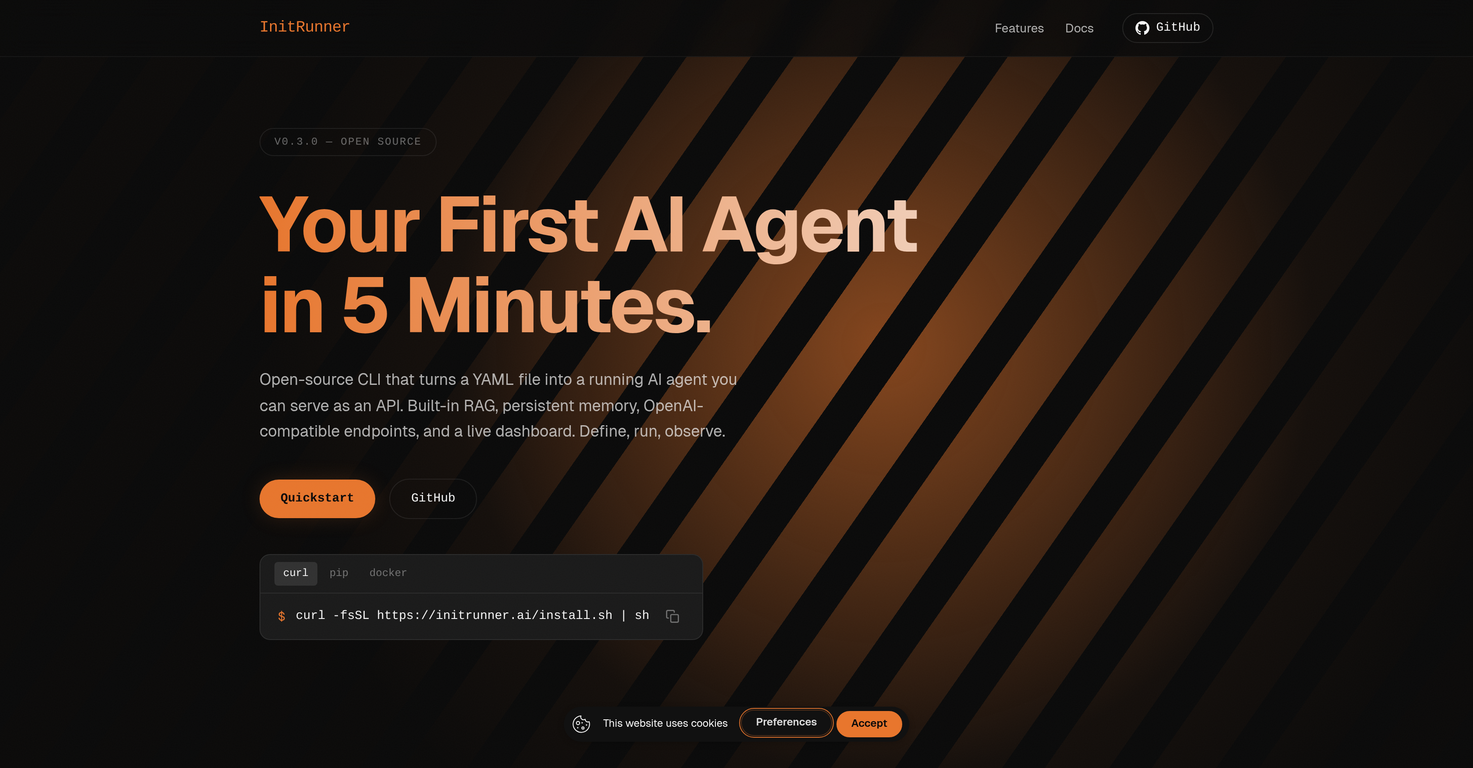
InitRunner is an open-source command-line interface (CLI) primarily designed to define AI agents as YAML and operate them directly from the terminal. It expedites the production of deployable AI technologies, with built-in features like Reasoning over Arbitrary Graphs (RAG), persistent memory, audit trails, and multi-provider accommodation. InitRunner can streamline the transformation of a YAML file into an operational AI agent functioning as an API, providing full control over the agent's attributes from end-to-end.
Can you describe the multi-provider support feature of InitRunner?
InitRunner's multi-provider support feature facilitates seamless transition between differing AI service providers. This ability allows users to evade vendor lock-in and enables the execution of work with various AI services. A change in provider can effectively be achieved by adjusting a single line in the YAML file.
What is the significance of InitRunner's ability to convert a YAML file into a running AI agent?
InitRunner's ability to convert a YAML file into a running AI agent is significant as it provides full control over defining the agent's roles, tools, and behaviours in an accessible and easily understandable format. This function enables the deployment of AI agents promptly and efficiently, without needing to code, making AI more user-friendly and widely utilizable.
How does the Reasoning over Arbitrary Graphs (RAG) functionality help while using InitRunner?
The Reasoning over Arbitrary Graphs (RAG) feature in InitRunner bolsters the AI agents' ability to reason and make decisions based on complex, non-linear information. This feature enhances the AI's problem-solving potential and facilitates more effective responses to multi-faceted challenges.
What are the key features of the live dashboard in InitRunner?
The live dashboard of InitRunner offers real-time monitoring and control over the AI agents. It provides an in-depth view of the agents' actions and decision-making processes, generating a comprehensive audit trail for each run. It also offers the potential to resume past sessions from memory, allowing for streamlined oversight and management of the AI agents.
How is the agent's role, tools, and behaviour defined within a YAML file in InitRunner?
In InitRunner, an agent's role, tools, and behaviour are defined within a YAML file. This approach allows for extensive customization of the AI agents, removing the need for programming knowledge and leaving the defining process accessible to all users. This form of configuration guarantees full control over an agent's attributes without needing to delve into code.
How does InitRunner ensure full auditability with its SQLite log feature?
InitRunner ensures full auditability by recording all inputs, tool calls, and outputs in an unalterable SQLite log. This persistent documentation guarantees that all actions and decisions made by the AI agents are accumulating and traceable, ensuring accountability and reliable record-keeping.
What are the benefits of InitRunner's flexibility in switching between different AI service providers?
InitRunner's flexibility in transitioning between diverse AI service providers prevents vendor lock-in, granting users the freedom to choose the AI services best suited to their work. This adaptability rises in effect when one provider's services no longer meet user requirements, allowing for provider switches with a simple YAML line change.
How does InitRunner support the execution of multistep tasks?
InitRunner supports the execution of multistep tasks by allowing AI agents to plan, carry out, and adapt when handling complex jobs that require multiple actions. This support fosters agent autonomy, paving the way for more effective task management and completion.
What are the built-in capabilities of InitRunner?
InitRunner's built-in capabilities consist of various features such as RapidAPI Gateway (RAG), persistent memory, OpenAI-compatible endpoints, a live dashboard, and more. These features provide the necessary tools for deploying complex AI systems, offering users comprehensive control and flexibility throughout the process.
Can InitRunner's tool prevent unexpected costs from excessive usage?
InitRunner can indeed prevent unexpected costs from excessive usage. Its automatic budget enforcement feature, set through the YAML file, restricts excessive usage, thereby avoiding surprise charges. This system works to halt any operation when the budget limit is reached.
How does InitRunner utilize session persistence and semantic memory?
InitRunner utilizes session persistence and semantic memory to develop smarter and more efficient AI agents. Session persistence allows the agents to resume where they left off, maintaining continuity across operations. At the same time, semantic memory enables agents to retain effective solutions for future recall, progressively improving the agents' performance over time.
How does InitRunner avoid vendor lock-in for users?
InitRunner mitigates vendor lock-in by allowing the swapping of providers with a single line change in the YAML file. This functionality offers users the freedom and flexibility to shift between various AI service providers as per their requirements, eliminating the risk of being bound to a single provider.
What functionalities are offered by InitRunner's RapidAPI Gateway feature?
The RapidAPI Gateway (RAG) feature in InitRunner serves to simplify integration with other RapidAPI services, encouraging the interchange and sharing of functionality. This feature cultivates a more well-rounded and versatile AI ecosystem.
What makes InitRunner a user-friendly AI tool?
InitRunner is considered a user-friendly AI tool due to its simplified approach to agent definition and deployment. By only requiring the creation of a YAML configuration file, InitRunner helps users define an AI's roles, tools, and behaviours without the need for extensive coding knowledge. This characteristic makes entry and navigation in AI scenarios easier and more accessible.
How does InitRunner support agent autonomy?
InitRunner supports agent autonomy by offering multiple features that facilitate independent decision-making and adaption to tasks. Agents can plan and execute multi-step tasks and adapt in the event of failure, developing a sense of autonomy and enhanced problem-solving capacity.
How is InitRunner operated through the terminal?
InitRunner operation is primarily conducted through terminal commands. Users can define AI agents as YAML configurations and then run them directly from the terminal, simplifying the deployment process and enhancing accessibility for those familiar with CLI usage.
How does InitRunner enhance functionality and auditability with tools like Github and filesystem?
InitRunner enhances its functionality and auditability by integrating various tools like Github and filesystem. Github allows for better version control and collaboration, while the filesystem facilitates local responsibility management. Together, these tools augment an agent's capabilities, provide new functionalities, and enable comprehensive auditing of the agent's actions.
What is the significance of defining agents as YAML in InitRunner and how does it benefit users?
Defining AI agents as YAML in InitRunner simplifies and speeds up the agent creation process. Because YAML syntax is human-readable and easy to learn, even users with minimal technical knowledge can define their own AI agents. This benefit democratizes AI, expands user control over the AI lifecycle, and reduces deployment time significantly.
Can users interact in real-time with InitRunner's agents and monitor their activities through the live dashboard?
InitRunner allows users to interact with running agents in real time and monitor their activities via the live dashboard. It provides real-time oversight into the agents' operations and offers control options, thereby fostering better understanding and management of AI agent behavior.