How does Modelence ensure code ownership?
Modelence is open-source and promotes versatile code ownership. It empowers users to maintain complete control over their code and data, with the flexibility to deploy their applications anywhere and withdraw at any time.
What built-in amenities does Modelence offer?
Modelence offers several built-in amenities such as authentication flows, user management, sessions, and roles. It also provides a built-in admin dashboard, which eliminates separate setups.
Does Modelence support user management and sessions?
Yes, Modelence supports user management and sessions. These features are built-in and form an integral part of the amenities provided by Modelence.
Is there a built-in admin dashboard in Modelence?
Yes, Modelence includes a built-in admin dashboard. This facilitates easier management and customization without the requirement of any separate setup.
What is the enterprise-scale database integration like in Modelence?
Modelence automatically integrates an enterprise-scale database in the applications built. This feature is present by default in all apps, eliminating any need for separate arrangements.
What does app observability entail in Modelence?
App observability in Modelence includes comprehensive monitoring with logs, traces, and performance metrics. These are actively monitored and acted upon by an AI agent to ensure smooth operation of the applications.
How does the managed cloud deployment feature work in Modelence?
The managed cloud deployment feature in Modelence allows you to deploy your applications to production with a single click. Scaling is managed reliably by the system, requiring no setup from the user's end.
Can I deploy my application with a single click using Modelence?
Yes, Modelence allows you to deploy your application with a single click. It simplifies and hastens the process making deployment to production hassle-free.
How does Modelence help monitor app performance metrics?
Modelence has an AI agent that proactively handles the task of monitoring app performance metrics. It looks at logs, traces, and metrics to ensure smooth operation.
What language are the applications built on in Modelence?
The applications built with Modelence are coded in full-stack TypeScript. This simplifies transitioning the project from the AI to a human developer at any stage.
What is the 3-step plan for app development in Modelence?
Modelence uses an easy 3-step plan for app development. The process involves describing your desired application to the AI, guiding the AI as it configures the app, and finally deploying the live app with a single click.
Can I deploy my Modelence application anywhere?
Yes, you can deploy your Modelence application anywhere. Its open-source nature allows you to have full control over your code and data, giving you the freedom to deploy as you please.
Does Modelence support infrastructure automation?
Yes, Modelence supports infrastructure automation. It does so by offering built-in amenities. These include tools for authentication, user management, sessions, and roles, which are all managed automatically.
Does Modelence require any setup for deployment?
No, Modelence requires no setup for deployment. It offers a managed cloud deployment feature, which allows deploying to production with a single click, and scaling reliably on autopilot, with zero setup needed on the user's end.
What is Modelence?
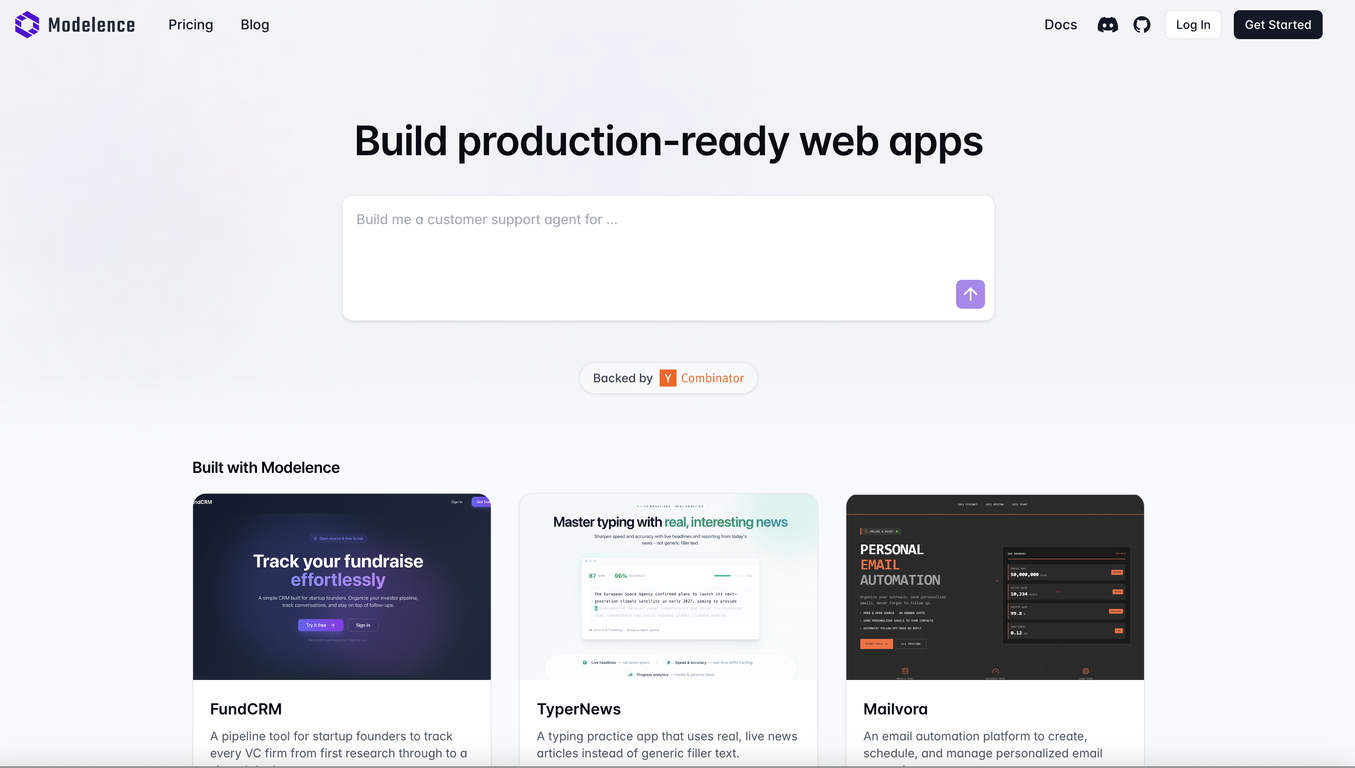
Modelence is a comprehensive, full-stack platform aimed at developing production-ready web applications. Unlike traditional AI builders that primarily generate prototypes, Modelence emphasizes on creating complex, user-ready applications. It provides a scalable solution, allowing users to initially use its AI wizard and transitioning to a human developer at a later stage. It is open-source, offering users complete control over their code and data, with the freedom to deploy their applications anywhere and withdraw at any time. Furthermore, it handles critical functionalities like authentication flows, user management, and session handling, with an in-built admin dashboard and default enterprise-scale database in the apps.
How does the AI-powered wizard in Modelence work?
The AI-powered wizard in Modelence uses natural language processing to understand the user's needs based on their description. Users guide the AI during the configuration phase and the AI intelligently constructs the application based on this guidance. It is a part of Modelence's easy 3-step plan for app development, where the user begins by describing their desired app to the AI.
How can I transition from AI to a human developer while using Modelence?
With Modelence, you can seamlessly transition from AI to a human developer. The platform is designed to grow with the user, initially leveraging AI capabilities but providing full-stack TypeScript code which developers can take over as required. This facilitates collaboration between the artificial and human intelligence throughout the development process.
What language does Modelence use for app development?
Modelence uses TypeScript for app development. It builds applications on a clean full-stack TypeScript, promoting an easy takeover by developers at any given phase.
Is Modelence a closed-source or open-source software?
Modelence is an open-source software. This means that the source code is freely available and can be modified or enhanced by users. This open-source nature is a critical aspect of Modelence, offering versatility in code ownership and deployment.
What types of features can I integrate into my app using Modelence?
Modelence provides a host of features for integration into your app. Some of these include built-in user authentication flows, user management, sessions and roles, a built-in admin dashboard and integrated enterprise-scale databases. It also offers full observability with automatic logging, performance metrics and tracing, which are proactively monitored by an AI agent.
Can I control my code and data using Modelence?
Yes, with Modelence, you retain complete control over your code and data. As it is built on an open-source framework, it gives users the freedom to deploy their applications anywhere, leave anytime, and maintain ownership of their code and data.
What is included in the built-in amenities provided by Modelence?
The built-in amenities provided by Modelence include user authentication flows, user management, session and role handling. It also comes with a built-in admin dashboard and integrated enterprise-scale databases by default, eliminating the need for separate setups.
How does Modelence's AI agent monitor logs, traces, and performance metrics?
Modelence's AI agent monitors logs, traces, and performance metrics in a proactive manner. It offers full observability, picking up on any anomalies or significant changes in the system's performance. These observances are then acted upon to ensure optimal functioning of the apps.
Does Modelence provide cloud deployment?
Modelence does provide managed cloud deployment. This means that users can deploy their applications on the cloud with a single click. The platform takes care of reliable scaling, requiring no setup from the user's end.
What are the steps to deploy an app using Modelence?
To deploy an app using Modelence, users follow a simple three-step plan. First, they describe the app they want to build. Then, they guide the AI during the configuration phase. Finally, the app is deployed with a single click and gets its own URL, database and user login.
How does Modelence handle scaling of the applications?
Modelence manages the scaling of the applications automatically, ensuring reliable growth even without any setup required from the user's end. With its managed cloud deployment feature, your app can scale reliably on autopilot.
Can applications developed with Modelence handle real-world user interaction?
Yes, applications developed with Modelence are indeed equipped to handle real-world user interaction. Modelence's focus on developing complex, production-grade applications means they are built to function reliably with real user interaction rather than just act as mere prototypes.
How does user management and authentication work in Modelence?
Modelence takes care of user management and authentication through built-in features, providing authentication flows, user management and sessions. It even handles role management out of the box. User roles can be modified, assigned, or revoked, offering a seamless user management experience.
What is the nature of databases integrated into apps built with Modelence?
The nature of databases integrated into apps built with Modelence are enterprise-scale and come integrated by default. This means that there is no need to set anything up separately and it facilitates large-scale data handling, ensuring robust and reliable applications.
How does Modelence facilitate the role management in the built applications?
Role management in applications built with Modelence is handled seamlessly through the platform's built-in features. It provides necessary roles out of the box, and allows for modifications, assignments, or revocations of these roles as necessary.
Does Modelence provide a built-in admin dashboard?
Yes, Modelence provides a built-in admin dashboard. This eliminates the need for separate setups and streamlines the management process, providing user management, session, and role handling interfaces in one consolidated platform.
What does zero setup deployment mean in Modelence platform?
Zero setup deployment in Modelence platform means that users can deploy their application to production without having to manually configure or set up any deployment processes. Deployment to production can be achieved with a single click, and reliable scaling is handled automatically by the platform.
What type of applications can I build using Modelence?
Modelence allows you to build production-grade web applications. It is designed for constructing complex, robust and reliable applications that are ready for immediate deployment and real-world user interaction.
What does it mean that Modelence was built on an open source framework?
Being built on an open-source framework means that Modelence's underlying code is freely accessible and modifiable. Open-source software promotes transparency, versatility and community-driven improvements. It allows for flexibility in deployment and lets users maintain full control and ownership of their code and data.