 KiloClaw - Managed 🦀
  Mini tools
Pamela
 Take back control of your time.
Go to 💼 Personal assistant
 Notis
Notis
 Alice - AI Automation App
 Assindo
 Littlebird
 Snow AI
 David One
 HaloMate
 Personal Computer by Perplexity
 UnreadAI
 Monica
 Atomic Bot
 AIChatOne
 Botlor
 Pickle
 Mavex
Mavex
 Martin
 Klipy
Klipy
 Macaron
 OwnAI
OwnAI
 Lyrio AI
Notis
1,001,201
Alice - AI Automation App
97,320
Assindo
54,759
Littlebird
52,115
Snow AI
30,909
David One
19,405
HaloMate
15,585
Personal Computer by Perplexity
13,230
UnreadAI
12,520
Monica
11,720
Atomic Bot
10,646
AIChatOne
9,551
Botlor
9,217
Pickle
8,338
Mavex
8,130
Martin
7,124
Klipy
5,785
Macaron
5,311
OwnAI
5,262
Lyrio AI
5,124
Go to 🚀 Productivity
📚
Knowledge
(234)
🔍
Research
(189)
📧
Email
(142)
🤖
Task automation
(90)
💼
Personal assistant
(89)
🔎
Search
(84)
📋
Task management
(80)
📝
Notes
(49)
💻
Operating systems
(46)
🌐
Web browsing
(41)
🎯
Goals
(30)
🔎
Problem solving
(24)
⌛
Time management
(20)
🗄️
Workspace organization
(9)
📈
Productivity advice
(9)
📝
Form filling
(7)
 TheLibrarian.io
 Supernormal App
 Saidar
 Runable
 Collate
 ComputerX
 AiAssistWorks - GPT Gemini Claude AI for Sheets Docs Slides
 MiroAI
 ConsoleX AI
 Skymel: Create Your Own Personal Agents
 Ask Steve
 Alfred by Simbli.ai
 Affint
 Kolva
Kolva
 Sup AI
 BrowseWiz
 Support Flow
 Octofy
 Hyperis
 Criticly
TheLibrarian.io
620,948
Supernormal App
162,435
Saidar
127,716
Runable
121,012
Collate
121,435
ComputerX
120,483
AiAssistWorks - GPT Gemini Claude AI for Sheets Docs Slides
108,002
MiroAI
90,296
ConsoleX AI
67,728
Skymel: Create Your Own Personal Agents
56,799
Ask Steve
51,880
Alfred by Simbli.ai
42,464
Affint
38,440
Kolva
37,555
Sup AI
35,706
BrowseWiz
34,659
Support Flow
33,354
Octofy
32,032
Hyperis
30,289
Criticly
27,485
Pamela
Take back control of your time.
Overview
Featured alternatives
Notis
Littlebird
 Edith
Edith
 VoicePod
 Good Assistant
Atomic Bot
Good Assistant
Atomic Bot
 Aivyx
Aivyx
Notis
1,001,201
Littlebird
52,115
Edith
2,764
VoicePod
13,999
Good Assistant
404
Atomic Bot
10,646
Aivyx
799
Overview
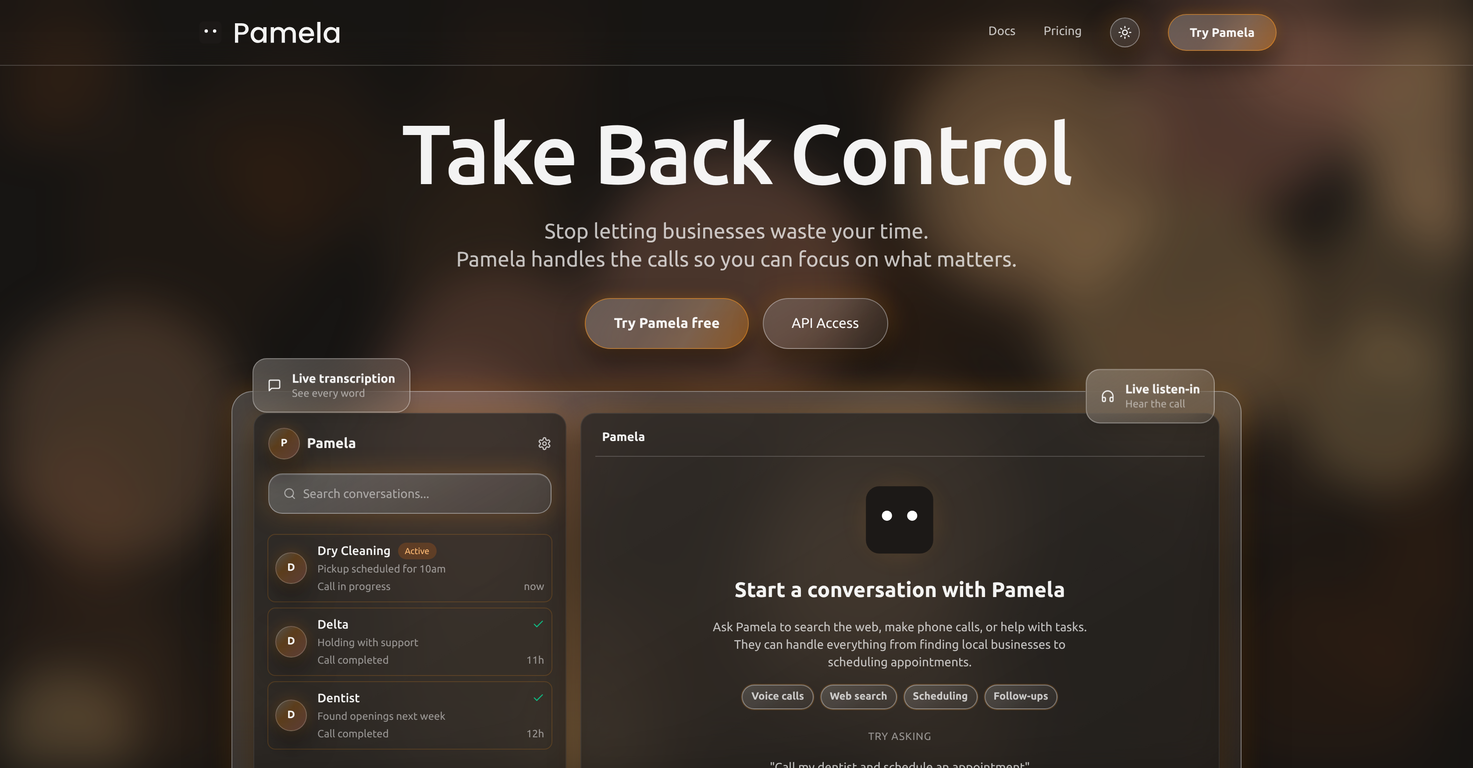
Pamela can call anyone to accomplish whatever task you set. It understands the details and context of your task that you provide and can you this to navigate phone trees, connect directly with people and intelligently respond to whoever its talking to. Pamela is your infinitely patient advocate. Users have used this to schedule meetings, confirm appointment details, place orders, make reservations, demand refunds from companies, cancel subscriptions and more.“AI agent that makes phone calls for you”
handles phone trees ("press 1 for x, press 2 for y....")
confirms appointments / gets info / waits on hold
live transcript + listen-in + jump-in
Pamela speaks English, French, German, Chinese
Show more
Releases
Get notified when a new version of Pamela is released
Notify me
February 24, 2026

Marcus Lima
Initial release of Pamela.
Author

Pricing
Pricing model
Freemium
Paid options from
$16/month
Billing frequency
Monthly
Refund policy
No Refunds
Top alternatives
-
Notis is the AI intern one message away from your entire tool stack. Dictate ideas, delegate the busywork, and watch it update everything from your CRM to your socials — right from WhatsApp, iMessage, Telegram, or emails. In this week’s release: - New billing tools: users can now cancel their subscription or activate paid billing directly through Notis via voice or chat. - Orchestrator guard and budget tracking fixes: failed or cancelled agents no longer silently eat budget, and the subscription guard no longer discards agents by running before the delegation limit check. - Notion is fully retired: all legacy Notion OAuth, sync, and database code has been removed from production. - Dropbox file handoff now works seamlessly between parent and sub-agents — no more lost attachments on delegated tasks. - Logout after account deletion now works correctly instead of leaving users in a broken session state. - Video message detection fix: CAF and other non-standard media types are now correctly identified, preventing transcription errors on voice messages.
-
Greg Rog🛠️ 1 tool 🙏 45 karmaMar 30, 2025@Alice - AI Automation AppThanks for noticing this Tyler, we really liked the idea of getting back to lifetime one-time purchases. Alice is a desktop app and it doesn’t use our cloud resources much, so this should be also feasible for the long run. Please, give Alice a try, you won’t regret it!
-
 Managed AI agent like OpenClaw but with real phone calls includedOpenThis app is really great it helped me with automation and also getting an AI assistant that sounds exactly like a human improved my productivity
 -
We surveyed hundreds of Littlebird users: ➡️ 84% say it saves them at least half a day per week ➡️ 80% say it's reduced their anxiety about dropping the ball ➡️ 77% describe the experience like having an EA who quietly takes notes on everything That's what happens when your AI has full context. Littlebird is an AI assistant that already knows your work. Every answer, draft, and plan is more relevant because it has the context behind it. It sees what's on your screen and transcribes your meetings, building a private memory of your projects and priorities. Littlebird connects the dots across all your apps and conversations, giving you answers grounded in your actual work. No integrations required. If you've seen it on your desktop, Littlebird has too. Just ask.
-
Being able to tell it to create an app for anything I want - for myself or for the AI to use is the coolest thing!
-
 Productivity-focused AI companion powered with tools from video understanding to web searchOpenVery good AI assistant, that helped me in my everyday life, by making the tasks for myself, asking David about the things I might not know and many more. I highly recommend.





#580
 4
4
4